
Last updated September 20, 2026
Full 25-point door and opener safety check with every visit - springs, cables, rollers, tracks, and your LiftMaster or Chamberlain opener included
You get a price before we start. It does not change when the truck arrives.
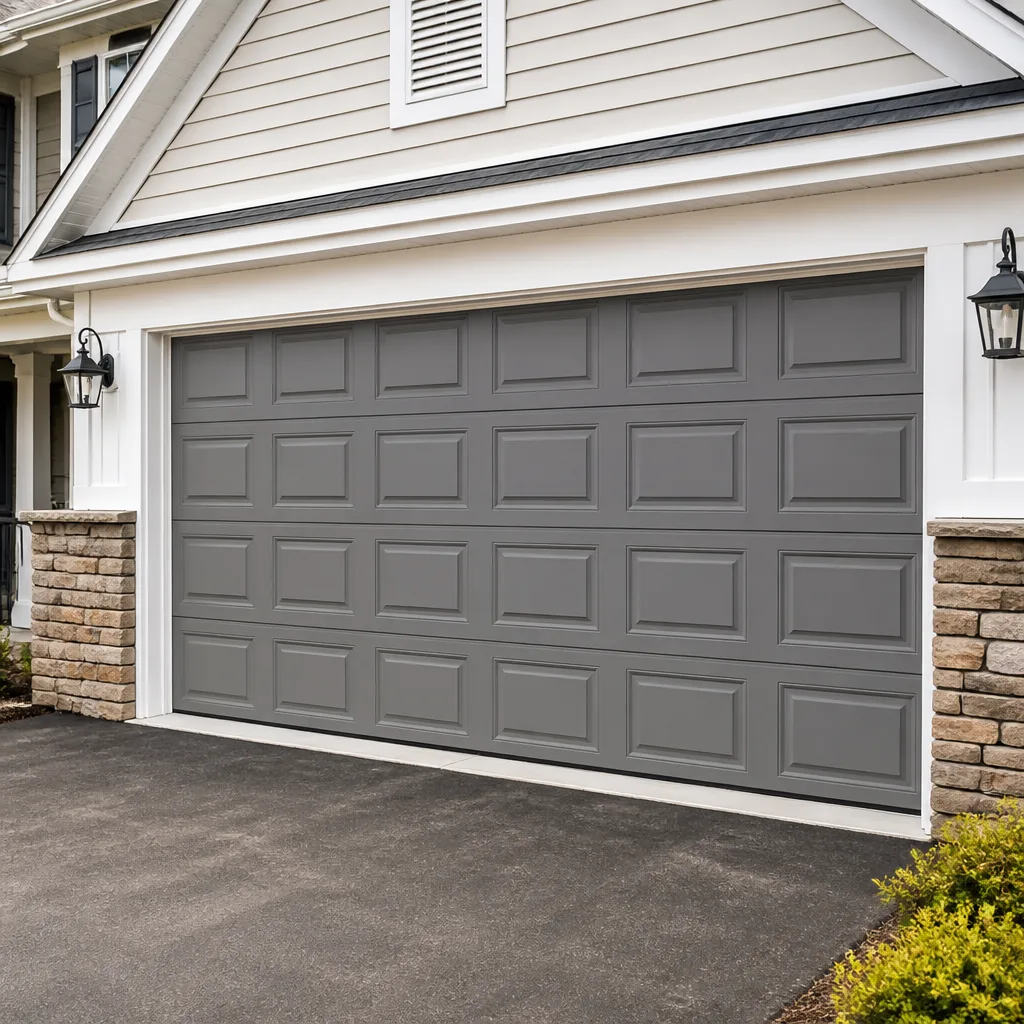
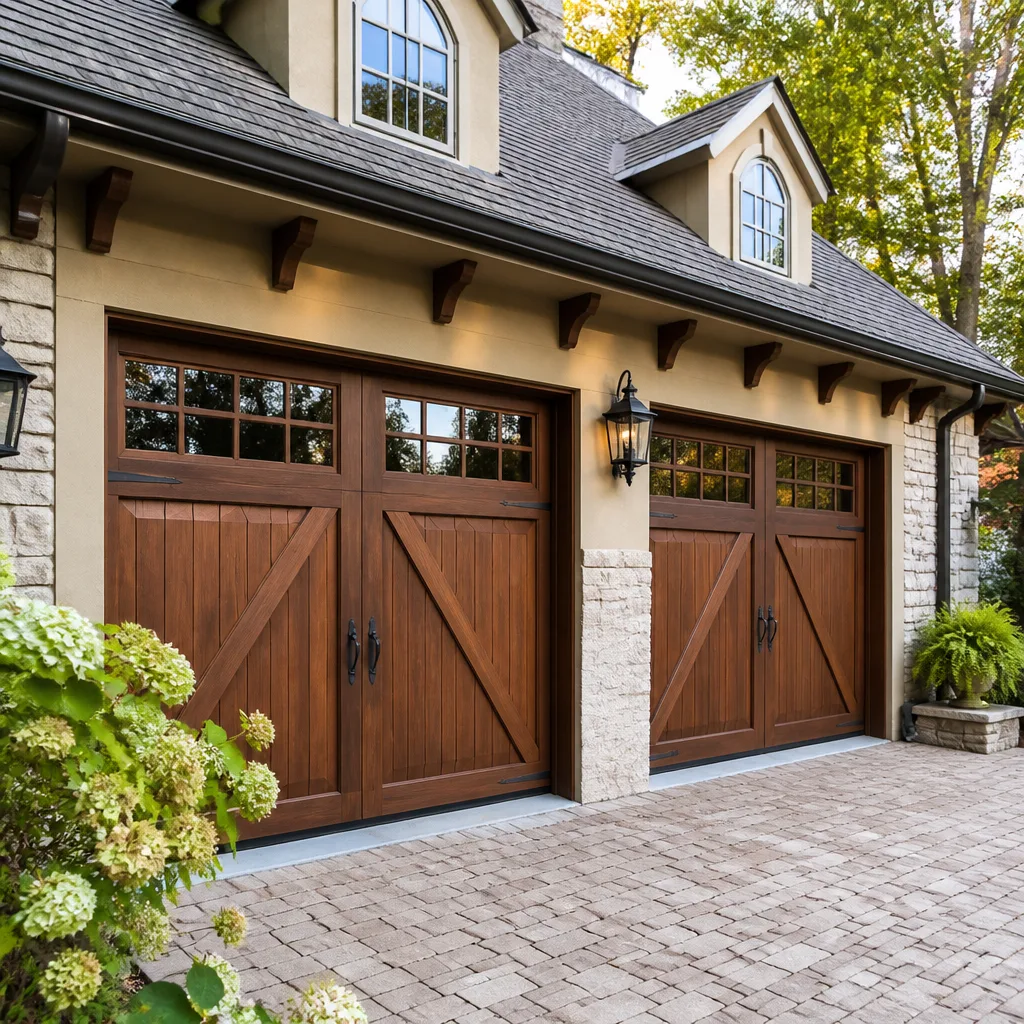
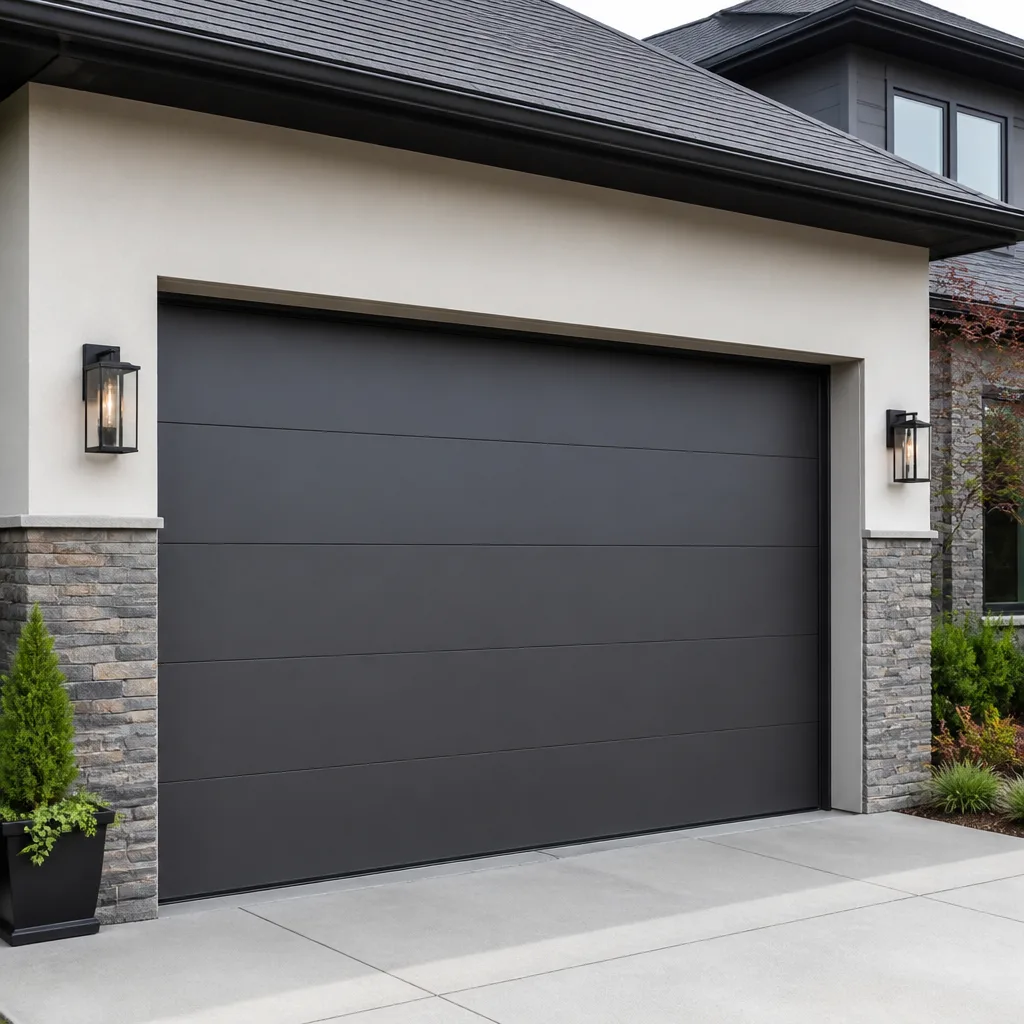
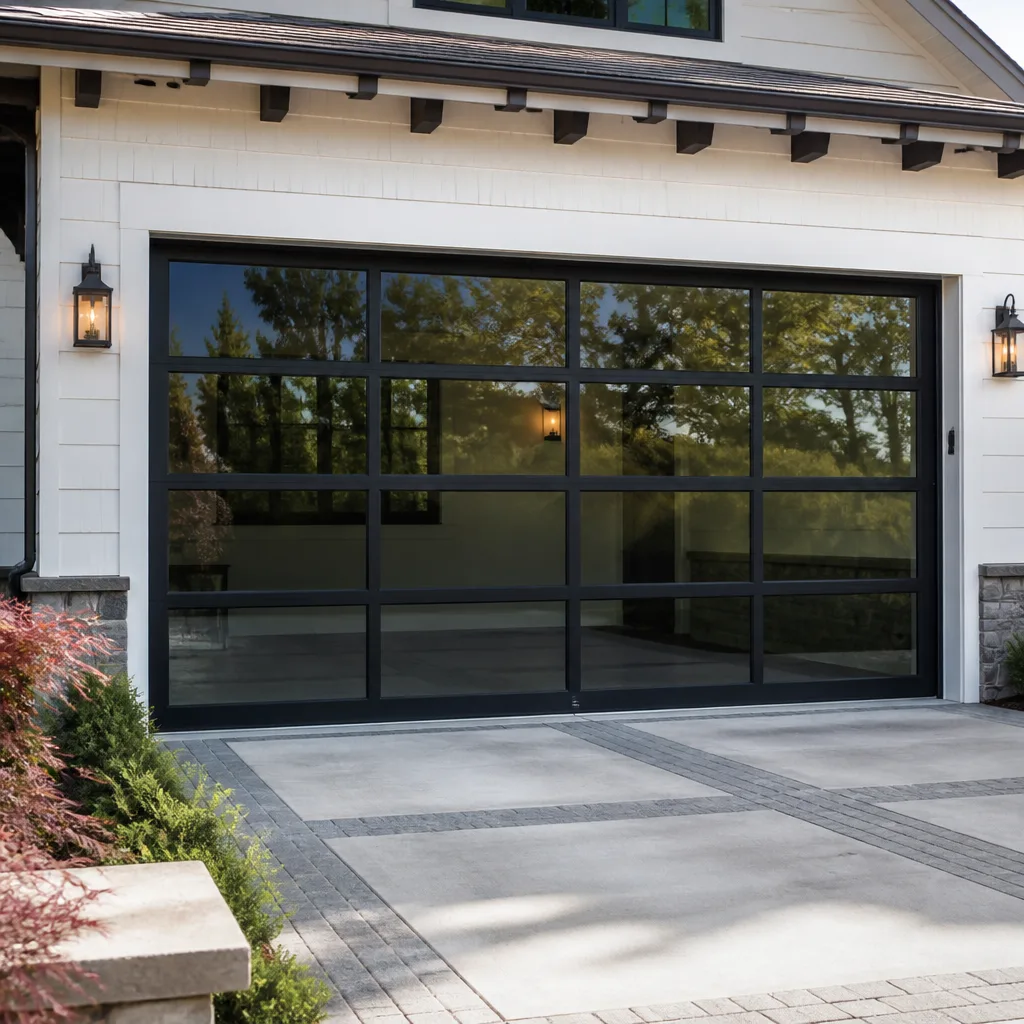
 Before
 After
After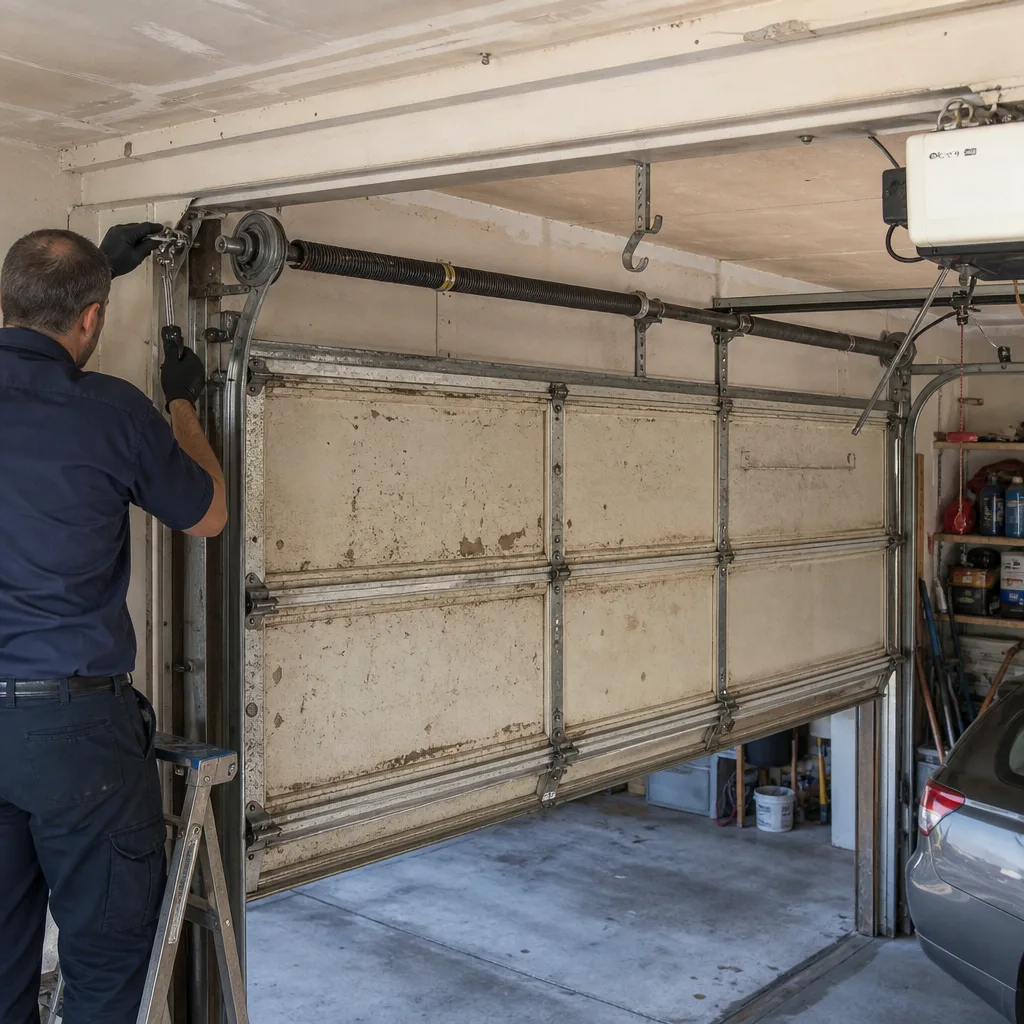 Before
 After
After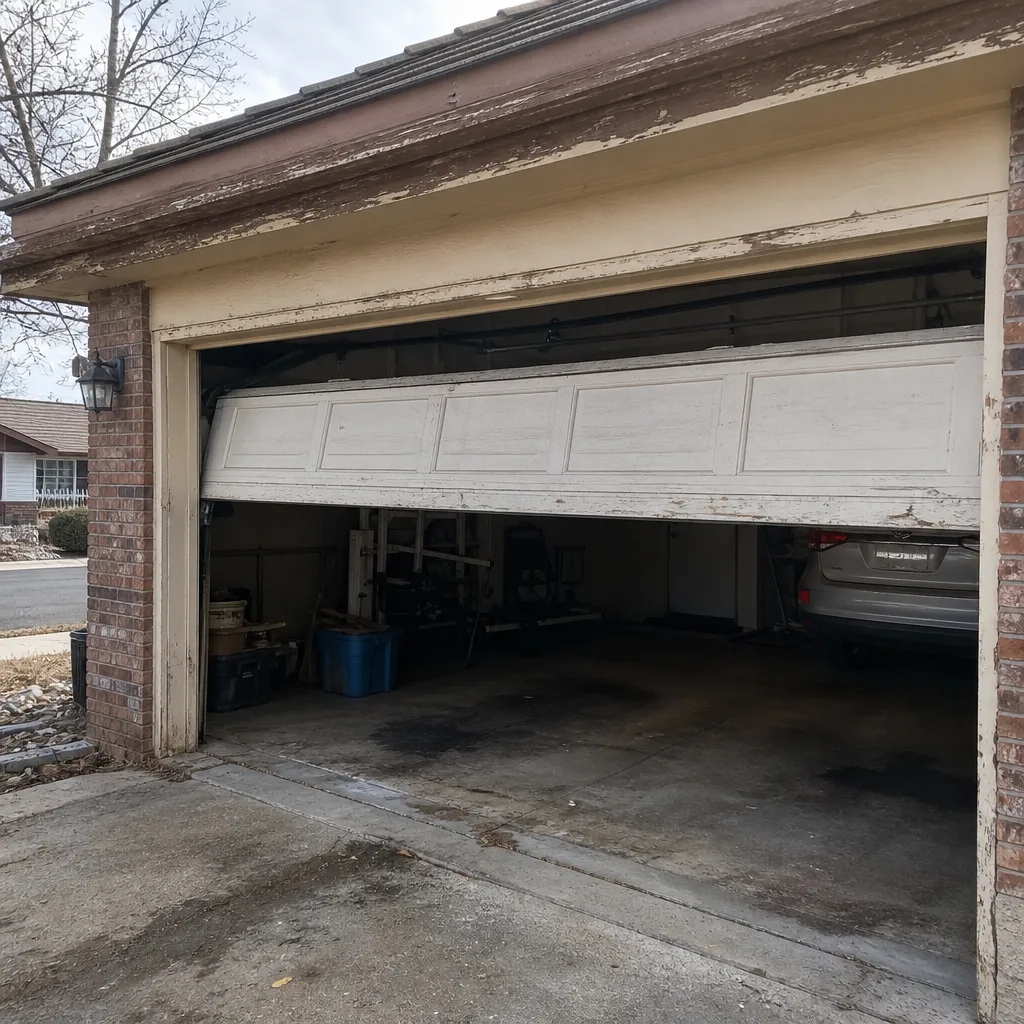 Before
 After
AfterThe Complete Guide to Garage Door in Littleton
Most Littleton homeowners replace a garage door without knowing which direction their garage faces, and that single detail changes which insulation R-value actually pays back within five years on Colorado’s Front Range. A west-facing garage in Littleton absorbs brutal afternoon solar gain in July, while a north-facing door never warms up enough in January to matter for insulation performance at all. This guide maps the full system: the springs that counterbalance the panels, the tracks that guide them, the insulation that affects both comfort and spring wear, and the service costs you should expect before you ever pick up the phone.
Quick Answer
A garage door in Littleton is a system of interdependent components where insulation choice affects spring load and spring load affects everything else. In practical terms, a standard double garage door repair in Littleton costs between $180 and $450 depending on whether the torsion spring, track, or opener is at fault, and a full replacement runs from $1,600 to $5,000 depending on insulation rating, material, and panel count. The single most important rule: get a written price for the complete scope before any work starts, because changes to any component cascade through the rest of the system. For a detailed look at what drives these numbers, see our Garage Door Cost Breakdown: The Littleton Homeowner’s Reference for 2026.
Table of Contents
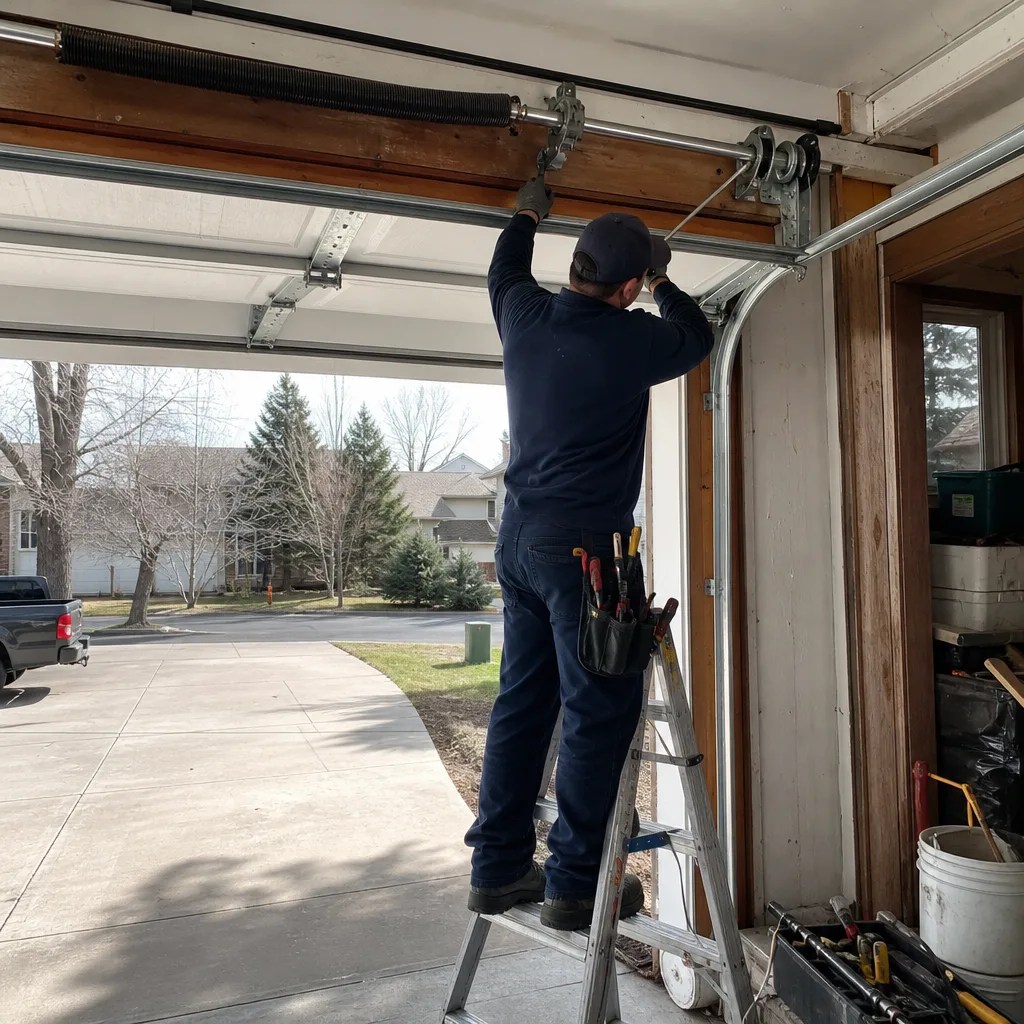
- The Anatomy of a Garage Door System
- How R-Value Works on a Garage Door (and Why the Test Method Matters More Than the Number)
- How Littleton’s Climate and Altitude Affect Your Door
- The Component Dependency Chain: What Happens When You Change One Part
- Average Littleton Repair Costs by Component
- How to Read a Garage Door Quote Line by Line
- Torsion Springs vs. Extension Springs: What You’re Actually Paying For
- Garage Door Openers: The Part That Fails in Ways Nobody Explains
 Before
 After
AfterThe Anatomy of a Garage Door System
When a Littleton technician says “your door is broken,” that sentence is about as precise as saying “your car needs work.” A sectional garage door has roughly 14 distinct serviceable components, and the one that failed determines whether you’re paying $140 or $900. Here’s every part that matters, what it does, and what it typically costs to replace in Littleton.
| Component | Function | Typical Littleton Replacement Cost | Expected Service Life |
|---|---|---|---|
| Torsion spring | Counterbalances the door’s weight so the opener or your arm can move it safely | $280-$420 installed for a pair | 7-10 years (rated in cycles, real-world usage varies) |
| Extension spring | Same counterbalance function on lighter, budget doors via cables and pulleys | $90-$180 installed for a pair | 5-8 years |
| Garage door opener | Motorized drive that raises and lowers the door via a chain, belt, or screw | $380-$750 including installation | 8-12 years depending on brand, model, and cycle load |
| Logic board | The opener’s control system: receives remotes, keypad, and safety sensor inputs | $100-$260 depending on the opener model | Varies widely; lightning strikes are a frequent cause of failure |
| Trolley carriage | Guides the opener arm along the rail; the part that “jerks” when the door moves unevenly | $75-$190 installed | 10-12 years; less with poor rail alignment |
| Rollers (nylon or steel) | Carry the door panel edges along the vertical and horizontal track | $12-$25 per roller installed | 5-10 years; nylon wears quieter |
| Weather seal (bottom) | Flexible rubber strip sealing the door bottom against water, snow, and insects | $75-$120 installed | 2-5 years, shorter with intense sun exposure |
| Track assembly | Vertical and horizontal steel channels that guide the door path | $180-$380 for bent/damaged track sections | 15-25 years, barring an impact or a seized roller |
| Cables | Transfer spring tension to the door and keep the door coming down evenly | $90-$180 installed for a pair | 5-8 years; fraying is the failure warning |
| Panels (individual section) | Faces of the door; a dented panel often looks like a full replacement but may not be one | $250-$600 per panel depending on material | 15-25 years |
| Safety sensors | Photo eyes at floor level that stop the door if an object breaks the beam | $60-$140 installed for a pair | 10-15 years; misalignment is the most common issue |
| Limit switch | Tells the opener where “fully open” and “fully closed” positions are | $70-$160 when integrated into opener repair | 8-12 years |
One component missing from this table is the one that causes the most arguments: the torsion spring. A garage door that’s “broken” is usually a garage door with a broken spring, and that spring failure is not a random event. It’s the predictable end of a load calculation made when the door was manufactured and modified by whatever insulation and panel choice the homeowner made at installation. We’ll get to that in the dependency section.
How R-Value Works on a Garage Door (and Why the Test Method Matters More Than the Number)
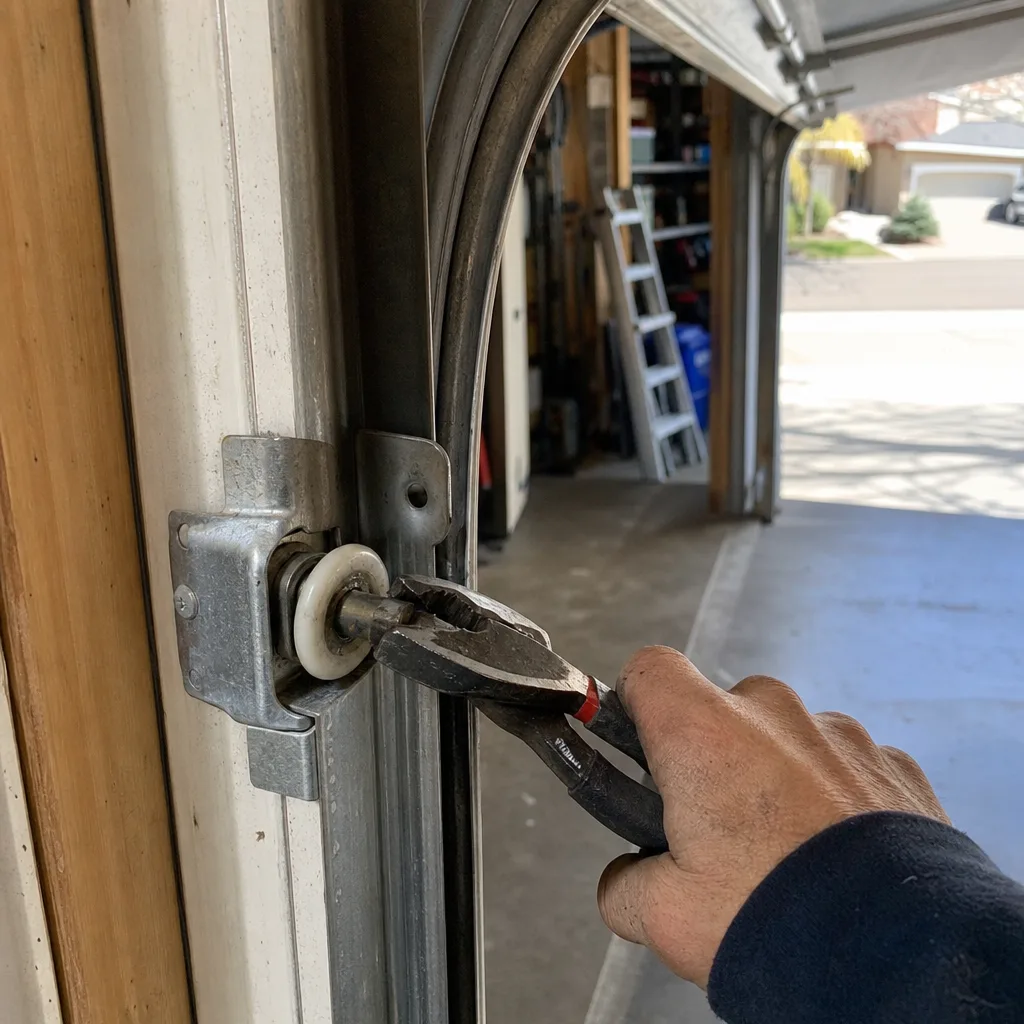
R-value is thermal resistance: the higher the number, the slower heat moves through the material. On a wall, R-13 to R-19 is standard for a Littleton home built under Colorado energy codes. On a garage door, a “high R-value” door might be R-18.4 on the spec sheet and perform like an R-8 door in practice, because garage door manufacturers are not all testing the same way. Some report core-only R-value, which measures just the insulation inside the panel. Some report the whole-door tested value, which accounts for thermal bridging along the edges. And some report a number for the panel face that has no meaningful relationship to the assembled door’s actual heat loss.
The honest way to read a garage door R-value: look for “ASTM C1363 whole-door tested” or “calculated whole-door R-value.” That’s the number that reflects reality for a Littleton garage on a 12°F January morning in the southwest part of the city, where the Big Dry Creek drainage keeps air moving all winter. A door labeled “R-18” with only a core claim will underperform a whole-door-tested R-12 door, and the R-12 door will often be cheaper because the manufacturer spent money on insulation, not on marketing.
Here’s what matters in practice for a Littleton homeowner:
- East- and south-facing garages: A whole-door R-10 to R-13 is sufficient. The garage absorbs morning and midday sun, which buffers the worst cold-and-hot swings. Spending more on R-16-plus rarely pays back within five years.
- West-facing garages: This is the Littleton orientation that justifies the upgrade. A west-facing door takes direct afternoon sun in July when ambient air is already above 90°F. A 2-inch thick polyurethane core (roughly R-18 whole-door) keeps the interior noticeably cooler and, critically, does not force the springs to do more work than they were already doing.
- North-facing garages: The honest answer is that insulation makes almost no measurable difference for garage comfort, because the garage never gets warm enough in winter for the delta to matter. You’re insulating primarily for the room above the garage, if there is one.
The rule of thumb from years of working on Littleton doors: insulation is worth paying for when the garage is attached, the door faces south or west, and the room above the garage is finished. In every other configuration, an insulated door is a comfort upgrade, not a payback calculation.
How Littleton’s Climate and Altitude Affect Your Door
Littleton sits at roughly 5,300 to 5,500 feet depending on the neighborhood, and the temperature delta is routinely 30 to 40 degrees between a January morning and that same afternoon. That swing does three specific things to a garage door system, and all three are things a technician in, say, Houston will never encounter.
First, the metal moves. Steel panel faces expand and contract measurably across a 100-degree annual delta. A 16-foot steel door gained and lost perhaps 3/8 inch across its width between the coldest winter morning and the warmest July afternoon. That’s why a door that seals perfectly in winter can look slightly “loose” in the frame come August, and why a technician who adjusts track spacing in winter will have callbacks in summer. In Littleton, track adjustment is seasonal by nature.
Second, spring tension is load-dependent, and load changes with temperature in a subtle but real way. Torsion springs are calibrated to a specific door weight. Cold metal is denser and a cold spring is slightly stiffer, which means a spring that was exactly balanced on an 85-degree evening is slightly out of balance on a -5-degree morning. Our technicians calibrate springs on the conservative side of the range to account for this, because a spring that’s a quarter-turn too tight in winter will slam the door upward in summer, and a spring that’s a quarter-turn too loose in summer will let the door fall too fast in winter.
Third, the altitude affects opener electronics less than most people think but affects thermal load more. At just over a mile high, the air is thinner and dry, which means solar gain is more intense on a west-facing panel face. This is not theoretical. In the Trailmark and Ken Caryl Ranch neighborhoods, we’ve measured 15 to 20 degree difference on the interior face of a dark-colored west-facing garage door between 9 a.m. and 4 p.m. in July. If the door is dark and west-facing and the door above is finished, insulation stops being optional.
The practical takeaway for Littleton: do not buy a garage door based on an article written for a flat, humid, low-altitude market. The numbers transfer poorly.
The Component Dependency Chain: What Happens When You Change One Part
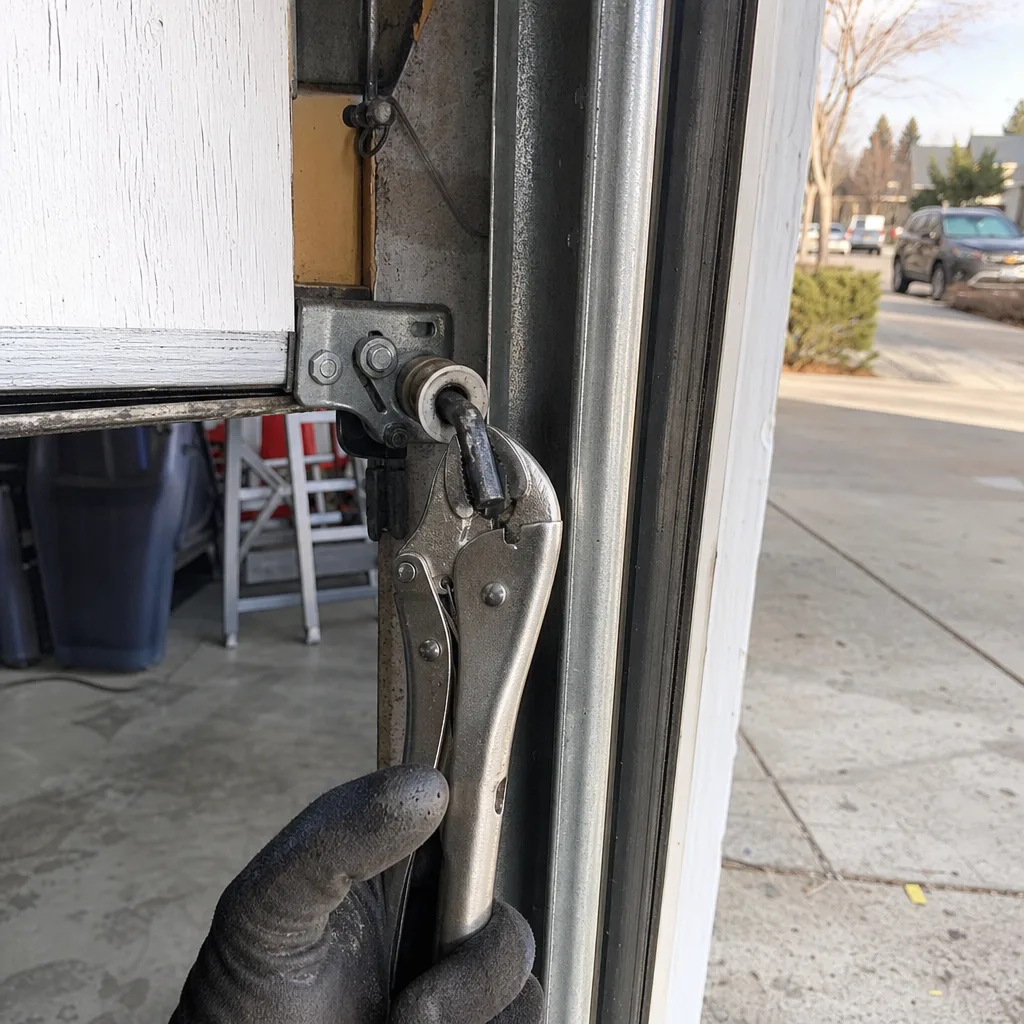
This is the section that matters most to a Littleton homeowner who wants to avoid a surprise invoice.
A garage door is not a collection of parts. It is a load-bearing system where each component is sized to the weight and balance of the door. Torsion springs are specified by wire diameter, coil count, and spring length against the door’s measured weight. The opener is specified by its lifting capacity against that same door weight plus the spring’s residual load. The track’s gauge and the roller’s bearing rating are specified against the panel weight and expected cycle count.
When a homeowner decides mid-project to change the panel material, three other components change, and usually none of them were in the original quote.
- The door gets heavier. A standard 16×7 non-insulated steel door weighs roughly 220 pounds. A fully insulated steel double-skin door in the same size weighs 360 to 400 pounds, depending on the panel thickness and core density. That’s a 60 to 80 percent weight increase.
- The springs must be resized. A spring pair rated for a 220-pound door is wildly undersized for a 380-pound door. The required spring wire diameter changes, the cycle rating changes, and the installed spring cost moves from about $280 for a standard pair to $380 or more for heavy-duty high-cycle springs. This is not an upsell. It’s physics.
- The opener may be marginal or undersized. A 1/2 HP chain-drive opener rated for a 220-pound door will technically move a 380-pound door for a while, but the motor will run hotter, the rail will flex more, and the opener will fail years earlier than its rated service life. If the opener is a 1/2 HP AC model from the late 2000s, a door weight increase means an opener replacement should be part of the same scope.
What this means for a homeowner’s buying decision: the moment you change panel material, panel thickness, or insulation, ask the supplier for the exact door weight at that size. Then ask whether the spring quote and the opener recommendation were calculated for that weight or for the “standard” door weight. If the answer is a blank look, you’ve found a supplier who quotes doors and hopes the springs work out.
In practice, we quote Littleton jobs as complete systems: door weight first, spring spec second, opener compatibility third. The quote reads in that order because that’s the order physics works in.
Average Littleton Repair Costs by Component
Every price below is a completed, installed price in the Littleton market, not a parts-only number. A huge chunk of the cost in any garage door repair is the labor and the service call, which is why a “cheap spring” online for $49 costs $300 installed. The spring is $49 and the 90 minutes of a trained technician’s time, the truck, the insurance, and the written warranty are the rest.
Double garage door torsion spring replacement: $280-$420. This is the most common repair in Littleton, and the variable is cycle rating: a standard spring rated for 10,000 cycles is the cheaper end, and a high-cycle spring rated for 25,000 cycles is the expensive end. Most homeowners should choose the high-cycle spring if they plan to stay in the house longer than five years, because the marginal cost of a better spring is about half the cost of another service call.
Single garage door torsion spring replacement: $220-$320. Same principle, smaller spring, lower price.
Opener motor failure (full replacement): $380-$750 installed. The range depends on whether the replacement is a base-model AC chain drive (the lower end) or a DC belt drive with smart connectivity (the upper end). Garage Door Opener Repair & Installation in Littleton gets into the specific model differences that matter.
Logic board replacement: $100-$260. If a lightning storm took out a board in a Littleton neighborhood near the city’s exposed utility lines, this is the fix. The part may be half the price if the opener is still under its motor warranty, and a competent technician will tell you that before quoting.
Cable replacement (both sides): $90-$180. Cables are under extreme tension and should never be replaced by a homeowner.
Track realignment or section replacement: $180-$380. A bent vertical track from a vehicle bump is a repair, not a replacement, and a good technician will tell you if that’s true before recommending a new door.
Full door replacement (double, installed): $1,600-$5,000 in Littleton. The low end is a non-insulated standard steel door from a volume manufacturer. The high end is a fully insulated double-skin door in a custom color from Clopay or Amarr or a wood-toned finish from an upper-tier Amarr line. Most Littleton replacements fall in the $2,400-$3,800 range.
Every number here should be a starting point for a written quote, not the quote itself. Garage Door Repair in Littleton goes into the diagnostic side of why a specific repair costs what it does. The honest thing about these ranges is that the final number depends on what your specific door weighs, what condition the track is in, and whether your opener is compatible with the spring you’re buying. That’s exactly what a written quote is for.
How to Read a Garage Door Quote Line by Line
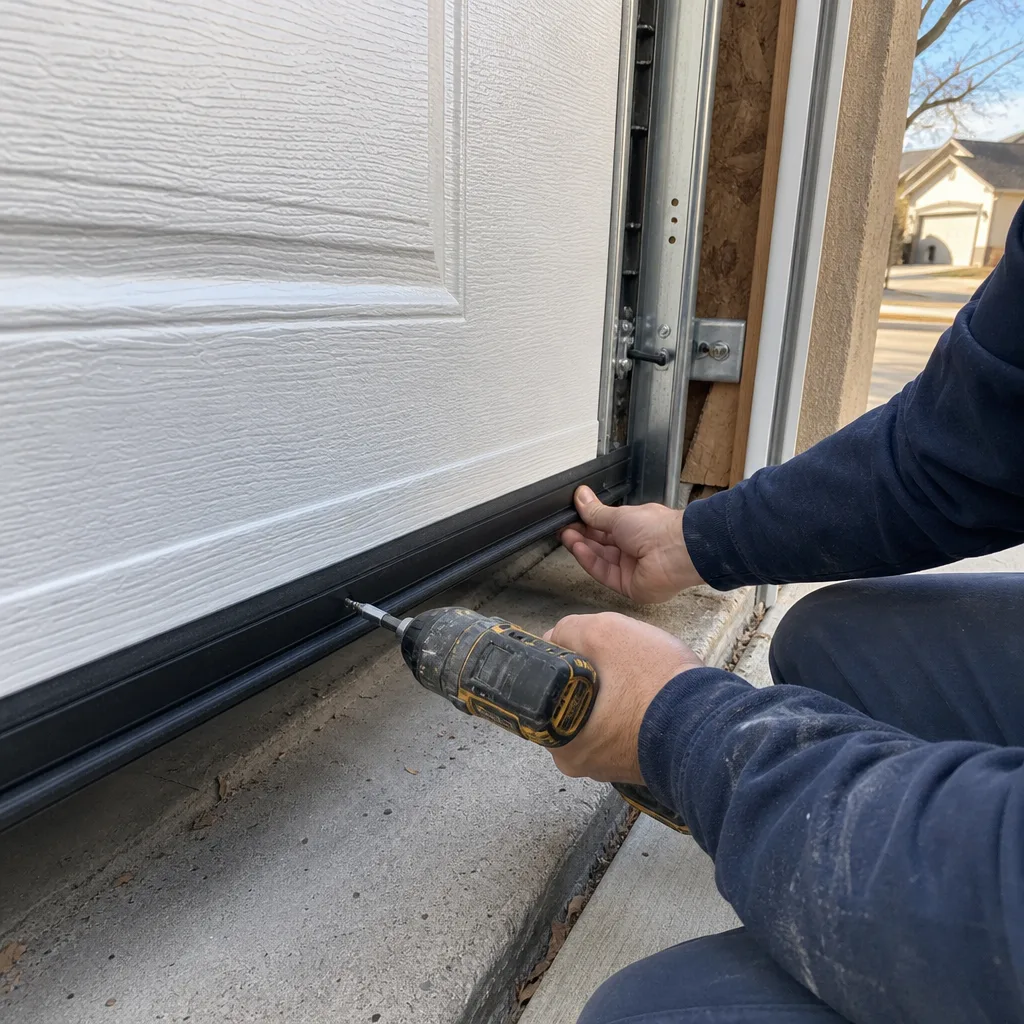
This is the highest-leverage section of this guide, because a Littleton homeowner who can read a quote is a homeowner who does not get upsold.
A legitimate garage door quote from a real operator has four sections. If a section is missing, the quote is not a complete price.
- Labor (service call or diagnostic). This is the fixed cost of the technician showing up, assessing the problem, and producing the written diagnosis. In Littleton, this runs $49-$89 on its own and is usually credited toward the repair if you proceed. A technician who shows up without a service-call fee may be charging more elsewhere in the quote or may be incentivized to sell you a more expensive repair to cover the trip.
- Parts, listed by exact part name. “Torsion spring pair, 0.225-inch wire, 24.5-inch length, 10,000-cycle rating” is a legitimate line item. “Spring kit” is not. If the quote says “door fix” or “tune-up” without naming the parts, you’re being quoted for labor plus vague hope.
- Labor for installation. This is the technician’s time to physically install the parts, test the balance, run a full open/close cycle, and adjust the limit switch. A flat labor number is standard. A labor number that is suspiciously high against the parts number is either a high-overhead company or padding.
- Warranty terms and duration. Any competent garage door company in Littleton states the warranty period in the quote, not in a phone call later. The industry standard is 1-year labor, 3 to 5 years parts on springs, and the opener manufacturer’s warranty on openers. Anything shorter than 1 year labor is a red flag.
Fixed charges vs. upsell candidates. The service call fee, the diagnostic labor, and the parts line items are fixed. The upsell candidates are the line items labeled “recommended tune-up,” “performance package,” “additional balancing,” or “premium inspection.” None of those are warranty requirements if the spring replacement includes balance testing, which it should. A company that quotes a spring pair at $320 and then adds a “spring tuning package” for $120 is charging you twice for the same 20 minutes of work.
The test for any quote: ask the technician to put the make, model, wire diameter, and cycle rating of the spring on the written quote before you sign it. A real operator has that information on the truck. An upseller has to call someone.
Torsion Springs vs. Extension Springs: What You’re Actually Paying For
Every sectional garage door in Littleton operates on one of two spring systems: torsion springs mounted on a shaft above the door opening, or extension springs mounted on tracks beside the door. Homeowners rarely specify the system; builders chose it when the door was installed. But the system determines what you’ll pay for every future spring repair, and it’s worth understanding.
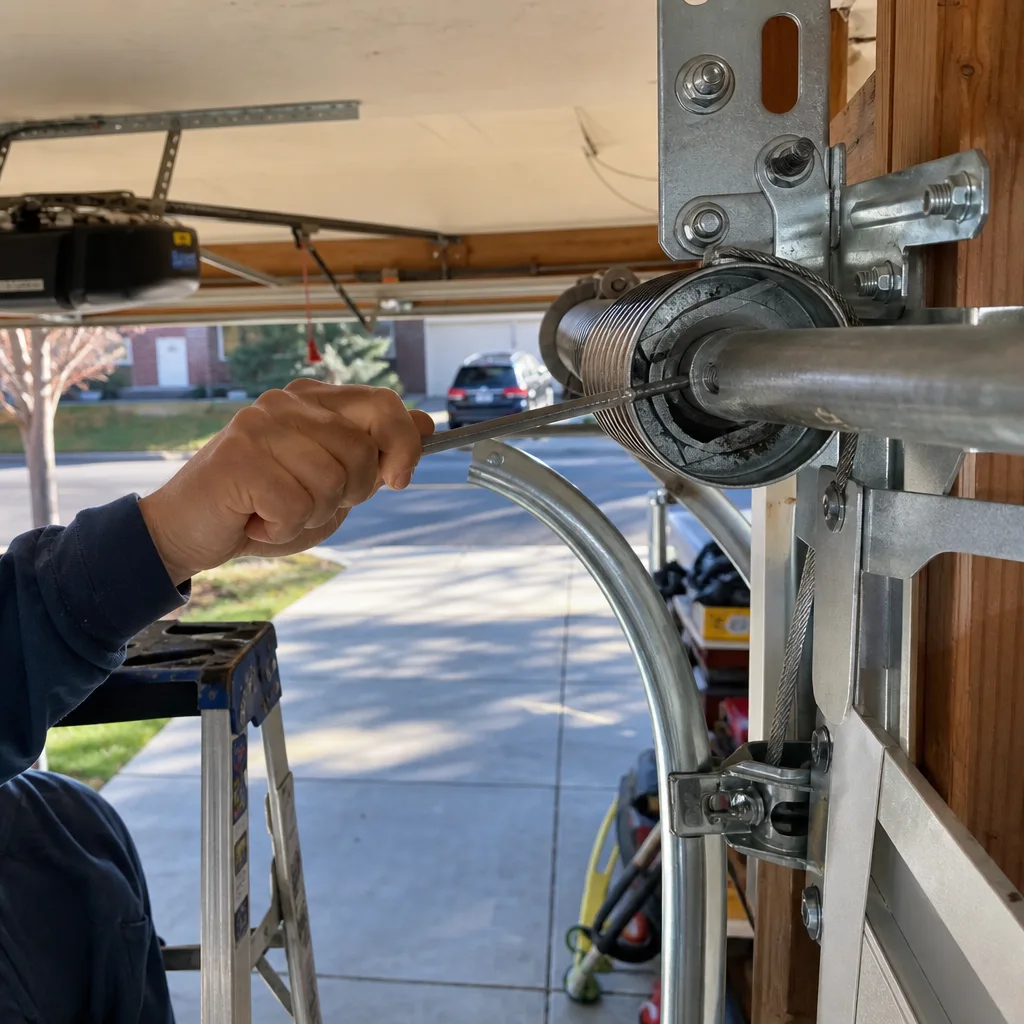
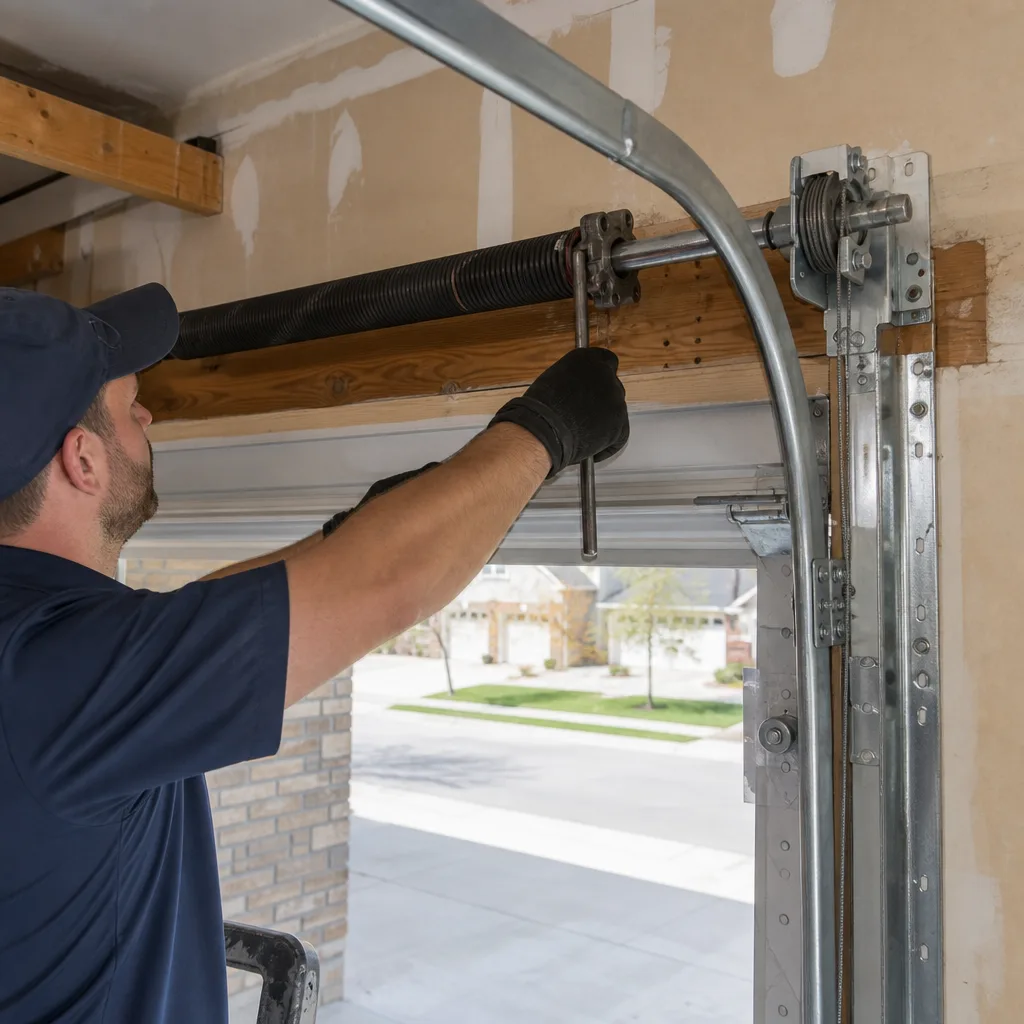
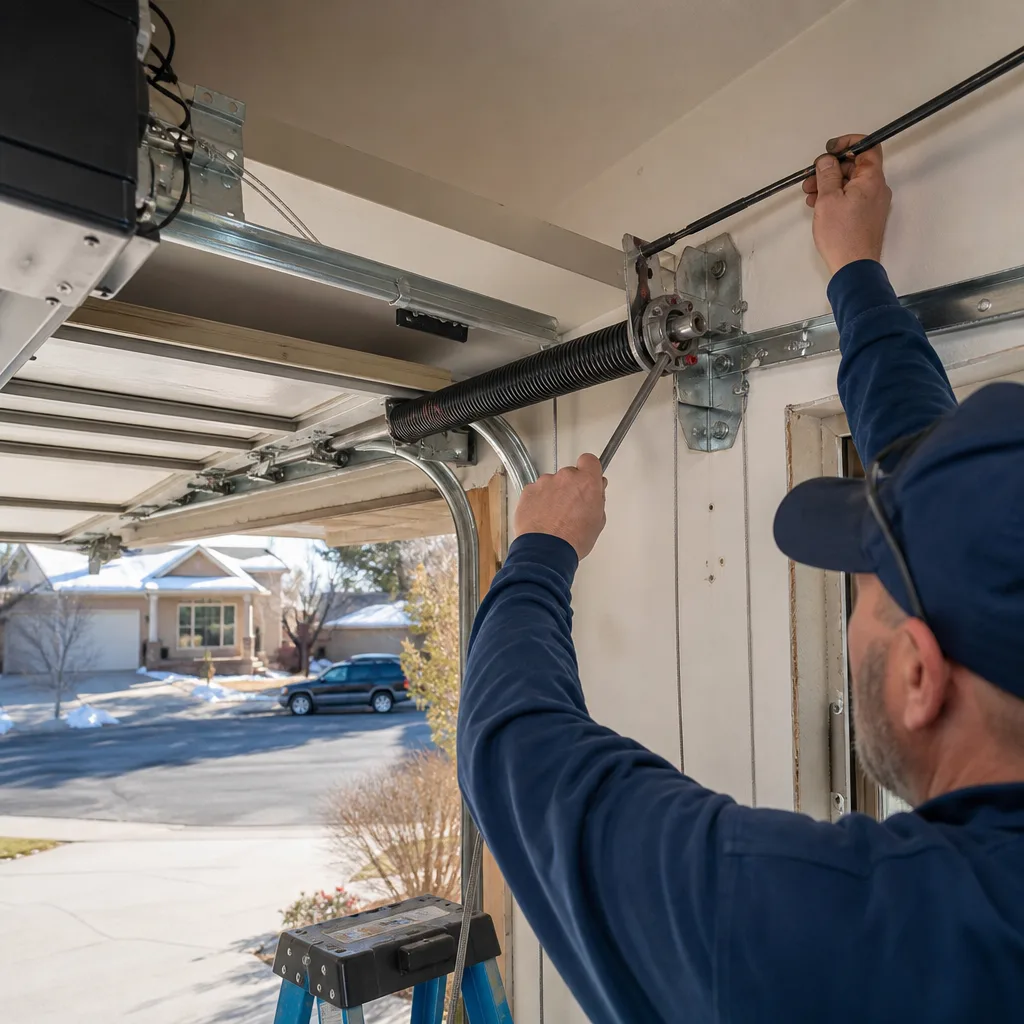
Torsion springs are the modern standard on any door installed since roughly 2005. They mount across the top of the door, store torque on a shaft, and release it as the door moves. Torsion springs are safer by design: when one breaks, it breaks within its coil and stays on the shaft. A torsion spring replacement is a two-spring job, because both springs share the load and wear at the same rate. Replacing one and not the other means the door will be out of balance by a quarter inch, and the older spring will fail within months.
Extension springs are the older, cheaper system. They mount along the horizontal tracks and stretch under tension when the door closes. When an extension spring breaks, the energy release is violent; the spring can come off its cable end and become a projectile. Any extension spring on a 2026 Littleton repair should be inside a safety containment cable or replaced with a torsion conversion. Extension spring replacement costs $90-$180 for a pair, but converting to a torsion system costs $350-$500 and makes every future repair simpler and safer.
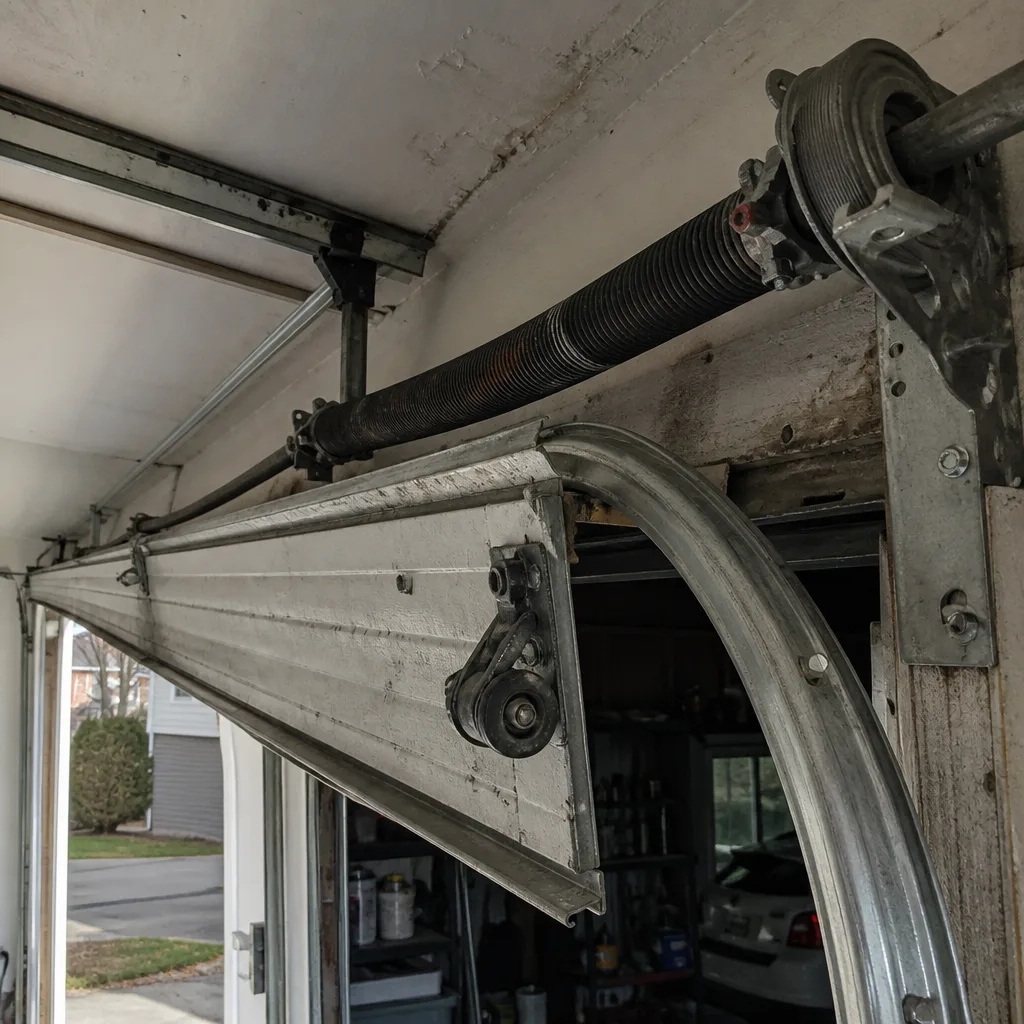
In our experience working across Littleton neighborhoods from the older stock in the Arapahoe Community College corridor to the 2015-and-newer builds near Chatfield Reservoir, we see extension springs mainly on doors from the 1990s and earlier. If your door was built in 2000 or after, you almost certainly have torsion springs. If you’re not sure which one you have, look at the top of your door: a torsion spring is the long horizontal coil above the opening. An extension spring is the stretched coil visible along the side track.
Why cycle rating matters more than brand. A spring’s life is rated in open/close cycles, not years. A typical USA door company rates a standard spring at 10,000 cycles. A high-cycle spring is rated at 25,000 to 30,000. In a Littleton household where the garage is used as the primary entry and exit, the door may cycle 3 to 4 times a day. That’s 1,300 cycles a year, which means a 10,000-cycle spring lasts about 7.5 years and a 25,000-cycle spring lasts about 19 years. If you plan to be in the house past 2030, the math is unambiguous.
Garage Door Openers: The Part That Fails in Ways Nobody Explains
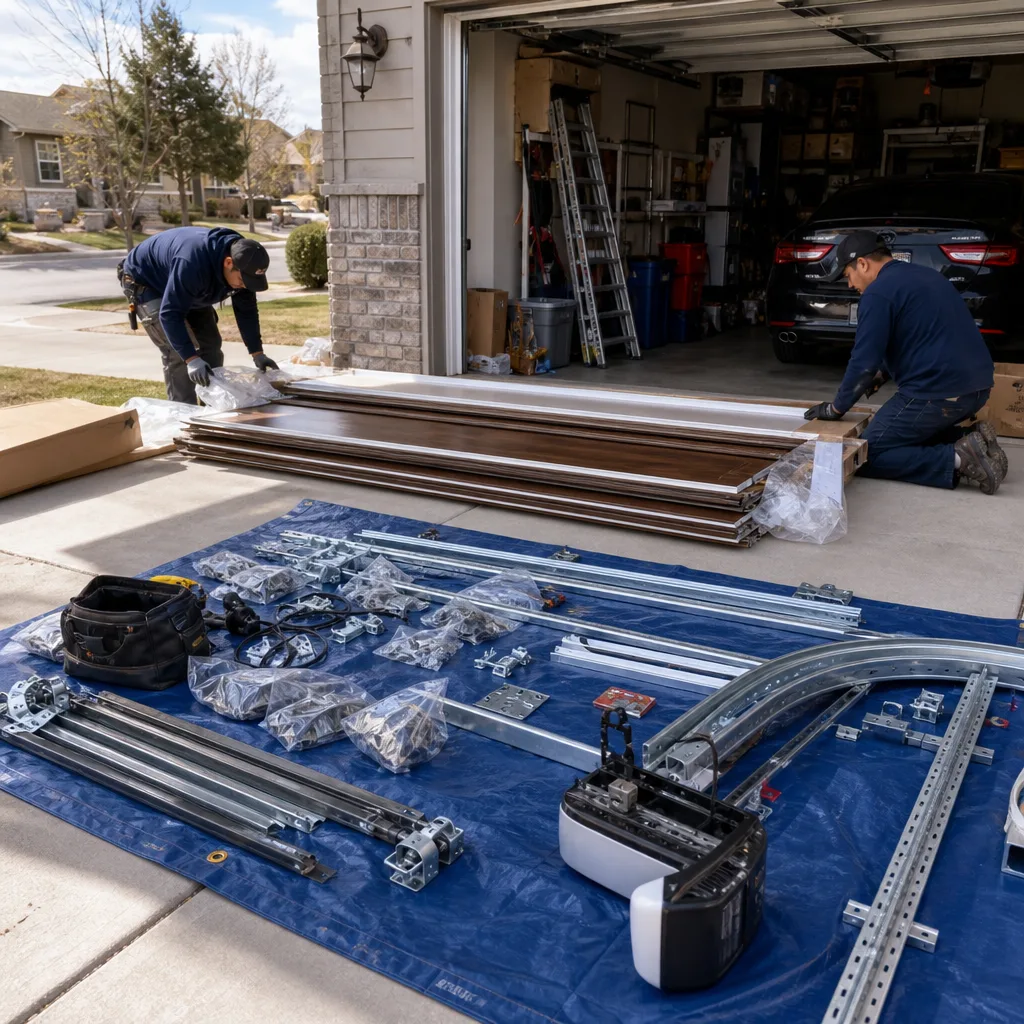
A garage door opener is a motor with a control board, a rail, a carriage, and a belt or chain. The motor almost never fails. The control board fails from electrical surges. The plastic gear inside the motor head strips. The limit switch drifts. The trolley carriage wears a groove in the rail. And in most cases, the failure is not “the opener died”; it’s the opener’s response to a door that was never properly balanced in the first place.
Here’s the common chain of events in Littleton, and why our technicians see it as often as a broken spring:
- A torsion spring breaks, and the homeowner doesn’t realize it for months because the door still opens with the opener doing all the work.
- The opener, now lifting a door without spring counterbalance, burns out the drive gear, strips the carriage teeth, or overworks the motor until the thermal overload trips regularly.
- The technician arrives to diagnose an “opener that stopped working” and finds a broken spring plus an opener that has been consuming itself for six months.
- The real repair is a spring replacement plus an opener replacement, and the opener portion could have been avoided if the spring had been replaced when it failed.
This is the strongest argument for an annual visual check of the springs that we know how to make: a $40 service call see-and-confirm beats a $700 opener replacement that could have been a $300 spring repair.
Brand compatibility and real-world reliability. The durable long-run brands in the Littleton market right now are Chamberlain and Genie on the opener side. Brand choice matters less than three operational specs: DC motor vs. AC motor (DC is quieter and smarter but has a more expensive logic board), belt drive vs. chain drive (belt is quieter and a better choice when a bedroom is above the garage), and the “smart” features (Wi-Fi connectivity, battery backup, and security camera integration). The last item matters more than most people expect: an opener with rolling-code encryption and a battery backup will still open your door in a power outage, which is common enough in Littleton during Front Range wind-and-lightning storms.
Common Mistakes to Avoid
- Buying a door based on a printed R-value without checking the test method. A “high-R” core-only rating in a west-facing Littleton garage is a comfort upgrade in the winter only and a heat trap in the summer. Look for whole-door tested values.
- Signing a quote that says “spring kit” or “opener repair” instead of named parts. A real quote names the wire diameter, cycle rating, or drive type. A vague quote is a blank check.
- Replacing a single torsion spring. Both springs wear at the same rate, and a mismatched pair causes an out-of-balance door that damages the opener within a year. Two springs or none.
- Treating a garage door opener as an electrical appliance rather than part of a load-bearing system. The opener is the weakest and cheapest component to replace, and it’s the one that suffers when the springs and balance are wrong.
- Waiting to replace a visibly frayed cable. A frayed cable is a failure in progress, and the failure mode of a cable under tension is a door that comes down unevenly or not at all, often while partially open.
- Skipping the paperwork on a door replacement. If the written scope does not include the door weight, the spring spec, and the warranty period, it is not a complete written quote. Walk away and get another one.
- Using a west-facing Littleton garage as a storage room with no insulation. The solar gain through an uninsulated west door will destroy adhesives, warp stored items, and make the space unusable between June and September. This is a climate-specific reality, not a general rule.
When to Call a Professional
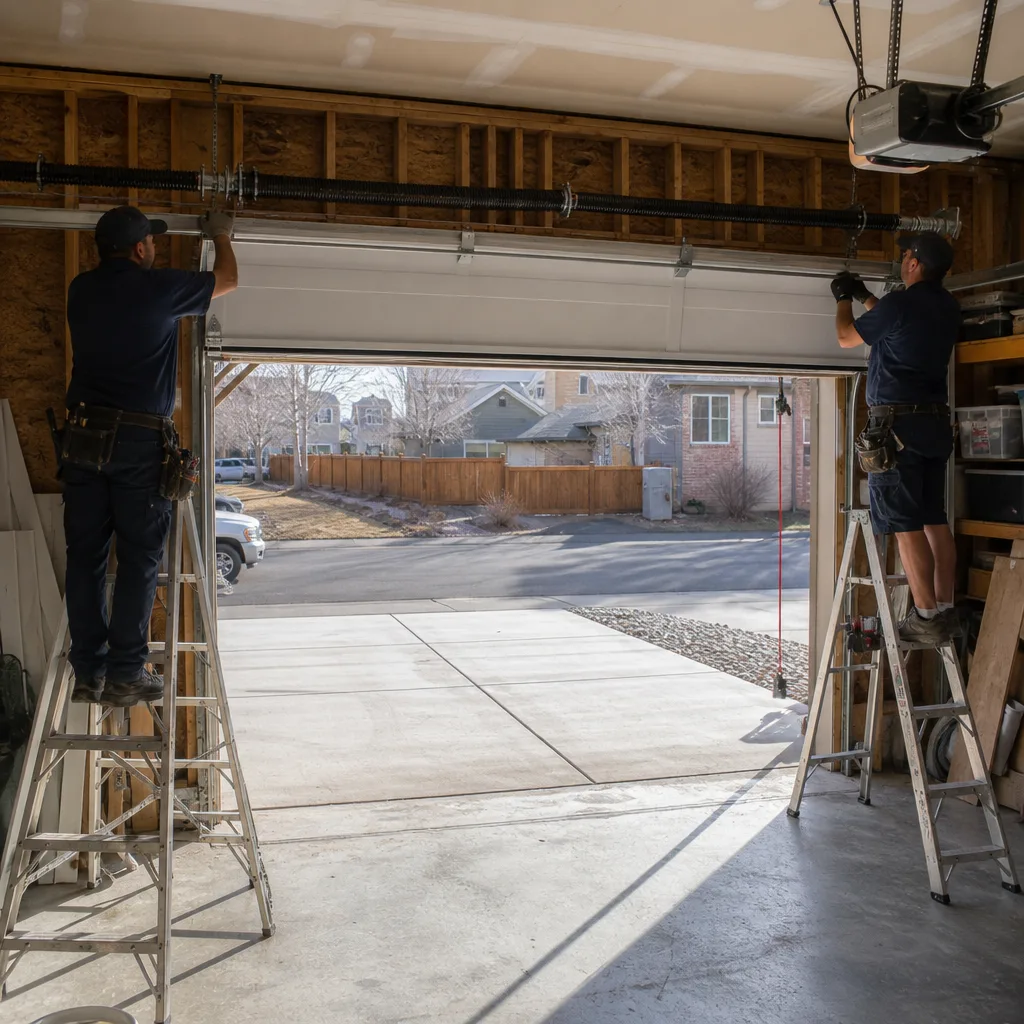
Some things on a garage door are genuinely doable by a homeowner with mechanical aptitude: replacing a weather seal, lubricating hinges, or inspecting rollers. Torsion springs, extension springs, cables, track repairs, and any work involving spring tension is not in that category. The stored energy in a wound torsion spring is enough to break a forearm or worse if it releases unexpectedly, and the bolts and cones require specific tools and techniques. If the issue involves spring tension, cable replacement, track removal, or an opener problem that is not a dead remote battery, call a professional before you start. Servo Garage Doors Littleton offers free estimates in Littleton, with a written price and written scope before any work begins. You can also browse more guides & resources on our blog. Call (720) 636-7083 and ask for the flat-price estimate. No call-center gauntlet, no recording, no upsell.
Frequently Asked Questions
A double torsion spring replacement in Littleton runs $280-$420 installed, and a single torsion spring pair runs $220-$320. The price depends on the spring’s wire diameter and cycle rating, and every spring should be quoted in writing with the cycle rating stated before you agree to the work. Call (720) 636-7083 for a flat written price on your specific door.
No. Torsion springs store enough energy to cause severe injury or death if the winding process is not exact, and extension springs require containment cables and specific tooling. A trained Littleton technician with insurance and a written warranty does this work in under two hours, and the cost is a fraction of the risk you take doing it yourself.
A well-installed steel door in Littleton lasts 20 to 25 years if the springs are replaced when they fail and the track is inspected annually. The climate shortens the life of weather seals and accelerates metal fatigue on springs, but the door panels themselves are durable. The weak point in a Colorado garage is almost always the spring system, not the panels.
Servo Garage Doors Littleton offers free estimates. There is no service-call fee, and the written quote includes a flat price and a written scope before any work starts. The founding rule is that the customer sees the failed part before anyone quotes a replacement, and the diagnostic visit is the first step in that.
A standard torsion spring is rated for about 10,000 open/close cycles, and a high-cycle spring is rated for 25,000 to 30,000 cycles. In a Littleton home where the garage door is the main entry point, a standard spring lasts 7 to 8 years and a high-cycle spring lasts 18 to 20 years. The high-cycle spring costs about $60 to $100 more per pair and is the better choice for anyone staying in the house longer than five years.
Ask for the door weight, the spring wire diameter and cycle rating, the opener’s horsepower and drive type, and the warranty period, all in writing. If the technician cannot produce those numbers on the spot, you are not getting a real quote. A complete quote from a competent operator reads like a parts list, not a marketing sentence.
The Bottom Line
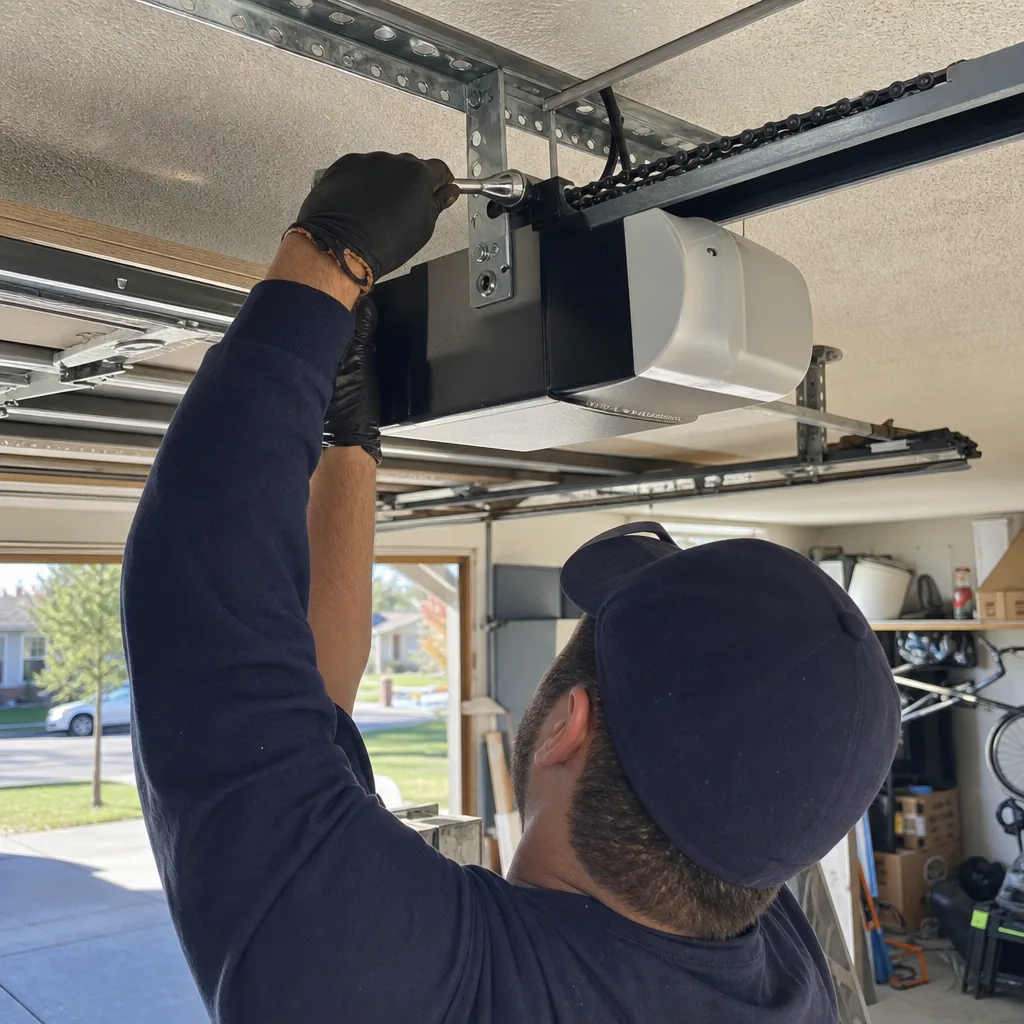
A garage door in Littleton is a system, not a purchase, and the three decisions that ripple through every future repair are insulation level, spring cycle rating, and opener compatibility. A west-facing garage justifies insulation; a north-facing garage does not. A high-cycle spring is a $70 upgrade that saves a $320 repair call five years from now. And every competent quote names the parts, the weight, and the warranty in writing before you sign anything. If a supplier cannot produce that paperwork, the price is not the problem. The problem is what is not on the page. The complete system has been in front of you this whole time. The only question is whether anyone shows you the photo of the failed part before they quote it.
Written by Marcus Deller, Owner at Servo Garage Doors Littleton, serving Littleton since 2015.